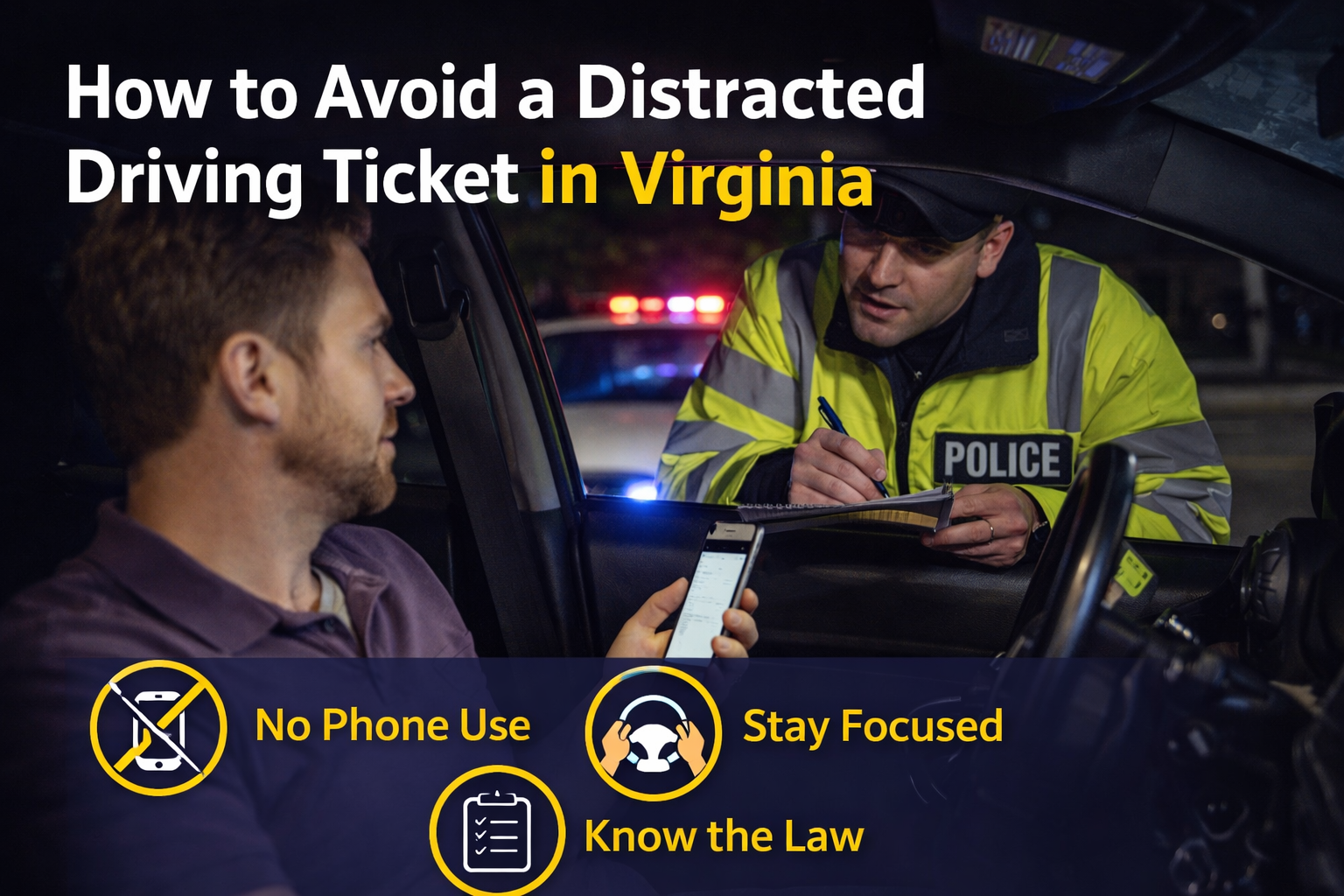
Distracted driving tickets in Virginia are not rare anymore. Law enforcement takes them seriously, the fines are real, and the consequences extend beyond your wallet to your driving record and insurance rates. The frustrating part is that most people who get cited did not think they were doing anything particularly dangerous. A quick glance at a notification, a two-second voice message, a coffee cup held in the wrong hand at the wrong moment — and suddenly you are pulled over explaining yourself. Here is what Virginia actually prohibits and how to stay well clear of a citation.

What Virginia Law Actually Says
Virginia’s distracted driving laws have tightened significantly in recent years. Holding a handheld personal communications device while driving is illegal — full stop. That means no holding your phone to make calls, no reading or sending texts, no scrolling, and no holding it for any reason while the vehicle is in motion. The law applies even when you are stopped at a red light.
Hands-free use is permitted, which means calls through a Bluetooth connection, voice commands through your car’s integrated system, or a properly mounted device you operate with a single touch are all legal. The keyword is handheld — if the device is in your hand rather than a mount or your car’s system, you are in violation regardless of what you are using it for.
First offenses carry a $125 fine. A second offense jumps to $250, and if distracted driving contributes to an accident, fines increase further, and demerit points go on your record. Virginia is not treating this as a minor infraction, the way some states still do — the enforcement reflects that.
Beyond Phones — Other Forms of Distraction
The phone law gets the most attention, but distracted driving covers more than device use. Eating, personal grooming, reaching for objects, and anything else that takes your attention away from the road can be cited under Virginia’s broader reckless driving statutes if an officer determines your behavior puts others at risk.
The three categories of distraction — visual, manual, and cognitive — rarely appear in isolation. Picking up your phone is all three simultaneously, which is why the data on phone-related crashes is so consistently worse than other distractions. But taking your eyes off the road to reach for a drink or adjusting your GPS at highway speed creates the same dangerous window.
How to Build Habits That Keep You Legal
The most reliable approach is removing the temptation before you start driving rather than relying on willpower once you are on the road. Put your phone on do not disturb before you pull out of the driveway. Connect to Bluetooth so calls come through your speakers automatically. Mount your GPS at eye level before you leave, rather than adjusting it while moving.
If you genuinely need to check your phone — a message you are expecting, a navigation update — find a safe place to pull completely off the road before touching the device. A few extra minutes is a reasonable trade for avoiding a fine, demerit points, and the actual safety risk that comes with taking your attention off traffic even briefly.
For teen drivers, these habits are particularly important to build early. New drivers are statistically more likely to be involved in distraction-related incidents, and the consequences for young drivers with graduated licenses are compounded by GDL restrictions that can extend their supervised driving period if violated. Getting the habits right from the beginning is significantly easier than trying to unlearn bad ones later.
Professional Training Builds the Right Foundation
Avoiding distractions is partly about knowledge and partly about the automatic habits that develop through proper training. A driver whose core skills are solid — smooth lane changes, confident merging, comfortable highway driving — is far less likely to reach for their phone out of anxiety or boredom than one who is still working hard just to manage the basic mechanics of driving.
The best driving school in Virginia is the one that builds those core skills properly, rather than just getting students through the minimum requirements to pass a test. Drive Well Driving School offers one-to-one driving lessons that focus on developing genuine competence and confidence, behind the wheel teens programs built around Virginia’s GDL requirements, and behind the wheel adults training for anyone who needs to build real road confidence, regardless of age.
Their online driver’s education covers the theory behind safe driving practices — including distracted driving laws — in a flexible format that fits around your schedule. Students who need to retake the permit test benefit from targeted online permit re-examination preparation rather than starting from scratch.
For drivers dealing with court requirements or insurance mandates, the online driver improvement clinic Virginia DMV approved program is available without the scheduling constraints of an in-person session. And for anyone who needs to retake their road test, Drive Well’s re-examination for road test preparation identifies what went wrong and builds the specific skills needed to pass with confidence.
Serving Northern Virginia Communities
Drive Well covers a wide area across Northern Virginia with flexible scheduling that works around real life. Whether you need a driving school Leesburg VA, a driving school South Riding VA, a driving school Herndon VA, or a driving school Chantilly VA — Drive Well’s instructors serve all of these communities without requiring you to travel far for quality instruction.
Get in Touch Today
Drive Well Driving School has locations at 44297 Pawnee Ter, Ashburn, VA 20147, 23567 Belvoir Woods Ter, Ashburn, VA 20148, and 41350 Canongate Dr, Leesburg, VA 20175. Call 703-817-5047 or visit drivewelldrivingschool.com to explore programs and get started.